
Skid Steer Bucket Size Guide: Choose Width and Capacity by Job
A bucket can fit the quick-attach plate and still be the wrong choice for the work. The practical starting point is the carrier’s published limits, the substance being moved, and the access you need—not a generic width chart.
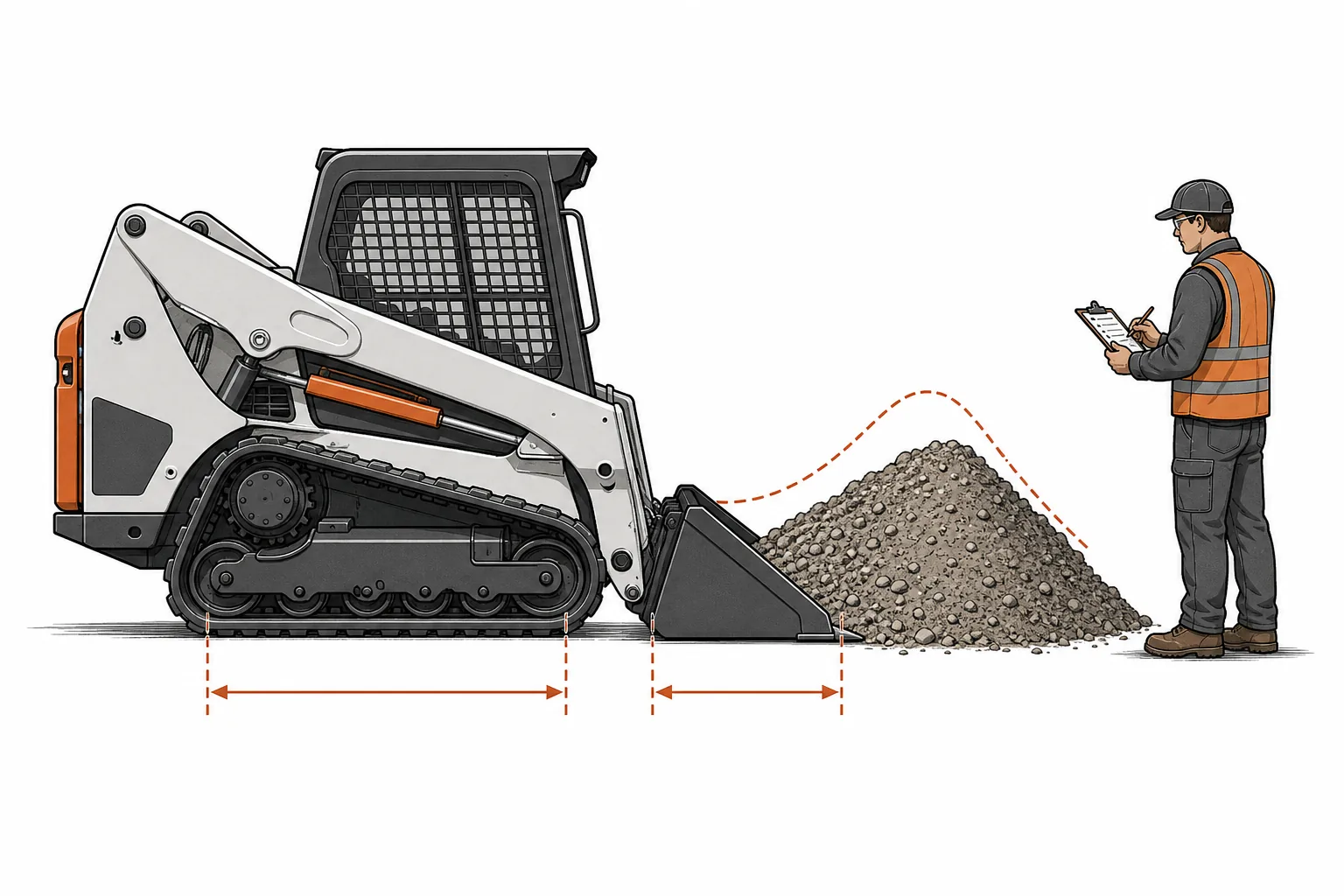
Select a skid steer bucket by checking the carrier’s manufacturer-published operating limits first. Then match bucket span to the task area and carrier stance, and match capacity to the substance and task. A mounting interface confirms mount fit; it does not by itself confirm that the loaded bucket is appropriate for the machine.
Start with the machine, not a generic bucket chart
The machine sets the boundary for every skid steer bucket-sizing decision. Before comparing buckets, pull the operator documentation for the exact loader and record its rated operating capacity, lift information, tire or track configuration, and mount interface. Those are carrier-specific facts. A chart that does not start there cannot tell you what is suitable while carrying material.
That matters because bucket capacity is only one part of a loaded setup. The bucket itself has weight. The material has weight. The carried position changes as the loader moves and lifts. For a purchase decision, use the carrier manufacturer’s published limits and the exact implement specifications rather than an assumed payload figure from a generic article.
Bring the exact make, model, configuration, and the work you plan to do into the conversation before you shop by width or capacity.
Match skid steer bucket size width to coverage, clearance, and stability
Bucket span should cover the task you need to do without creating an access or handling problem. A wider bucket can help on open grading or cleanup work. It can be less useful when a project has gates, tight paths, uneven ground, or a machine configuration that makes a wide load harder to place. Width is a work-area decision as much as it is a capacity decision.
Do not select a broader bucket only because it appears to offer more volume. The material may become the limiting factor before the physical capacity is full. The machine may also need room to pass through the actual site. Measure the narrowest route and compare it with the carrier and implement setup you intend to run.
| Decision | What to verify | Why it matters |
|---|---|---|
| Work width | Access routes, gates, walls, and the finish width needed | Prevents selecting a bucket that cannot work where the carrier must travel. |
| Machine stance | Exact tire or track configuration and manufacturer documentation | Keeps the choice tied to the actual loader rather than a generic model family. |
| Bucket span | Exact attachment specification | Lets you compare coverage and clearance before ordering. |
Select span for the site and the carrier you operate, not as a shortcut for increasing load volume.
Match capacity to material and bucket weight
Capacity must be considered with the substance being carried and the empty weight of the attachment. Loose material, aggregate, snow, soil, and demolition debris do not load the same way. A capacity label alone is not a safe payload recommendation for every substance or every loader.
Use the exact implement manufacturer’s capacity and empty-weight information, then compare the intended use with the carrier manufacturer’s operating guidance. If either data point is missing, stop short of a numeric conclusion. Ask for the specification instead of filling the gap with a rule of thumb.
- Identify the substance and task.
- Confirm the exact implement’s empty weight and stated capacity.
- Check the carrier documentation for its operating limits.
- Ask the seller to confirm the complete carrier-and-implement combination.
Select the bucket type for the task, not the marketing label
The right bucket type follows the substance and task. “General purpose” is a starting category, not a complete fit decision. Construction details, cutting-edge condition or design, and the substance you plan to move all belong in the comparison.
General-purpose and dirt work
For ordinary dirt and general material handling, confirm the bucket’s stated use and the carrier fit. The key question is not whether the label sounds broad enough; it is whether the documented implement and carrier combination matches the task.
Grading and cleanup
For grading or cleanup, width and edge configuration can matter as much as nominal capacity. Describe the finish you need and the task area when requesting a recommendation. That gives the seller information a product title cannot carry.
Rock or demolition material
Rock and demolition tasks call for an exact conversation about substance, bucket construction, implement weight, and the carrier’s published limits. Do not regard a bucket that mounts as automatically appropriate for dense or irregular material.
State the material, task, loader model, and mount interface together. A meaningful recommendation needs all four.
Read listing terms as prompts to verify, not as load limits
A listing may show a cubic figure, a heaped figure, or a general-purpose description. Those terms describe a bucket profile or stated capacity; they do not replace the carrier documentation for the substance you will move. Ask whether the implement is intended for digging, moving gravel, snow, light soil, heavy debris, or another specific substance.
For example, compact equipment used in landscaping can need a small implement for access, while larger carriers can have a different range of suitable buckets. Different materials, large machines, and large loaders can change that comparison; skid steers should be matched to their documented limits. Check cutting-edge wear, edge design, and the stated application before comparing options. A common mistake is treating an ideal listing description as proof that one setup suits every carrier.
Efficiency comes from matching the equipment to the site. If tipping is a concern, keep the conversation tied to the published operating guidance for the exact carrier and the substance being moved. That is more useful than copying a conversion table or relying on generic claims about what a bucket can carry.
Use this pre-order fit checklist for skid steer equipment
Before an implement ships, the cleanest decision is a documented fit check. Iron Equipment confirms attachments against the buyer’s exact make, model, flow rate where applicable, and hitch before shipment. For a bucket, bring the same discipline to the task and the carrier.
- Loader make, model, and configuration
- Rated operating capacity and relevant lift information from the manufacturer documentation
- Tire or track configuration and the tightest access width on the job
- Substance to be moved and the primary task
- Attachment interface and the exact implement under consideration
- Any hydraulic requirement that applies to the implement setup
This is not for a buyer who wants to select from a generic chart without carrier details. It is for an owner-operator who wants the implement decision checked before freight is committed. If an implement does not fit the confirmed machine, Iron Equipment states that it pays the freight both ways; ask the team to confirm the policy and the exact configuration before purchase.
Frequently asked questions
How do I choose the right skid steer bucket size?
Start with the exact carrier’s manufacturer-published operating limits, then compare the task area, material, bucket empty weight, capacity, and mount interface. The correct size is the one that fits the carrier and the task together; a generic chart cannot replace model-specific documentation.
Is a wider bucket always more productive?
No. A wider bucket may improve coverage on an open job, but access width, machine configuration, substance, and loaded handling can be the limiting factors. Compare the actual task area and the carrier documentation before using width as the deciding variable.
Can I use bucket capacity as a payload number?
No. Capacity describes volume, while the appropriate loaded setup also depends on material, implement weight, and the carrier’s published operating guidance. Use exact manufacturer specifications and ask for fit confirmation when the application is uncertain.
[A VERIFIER] Confirm the exact carrier and implement specifications before any purchase decision; this guide deliberately contains no model-specific load, capacity, or dimensional claim.
- Use the operator manual and published specifications for your exact loader and bucket before making a load decision.
- OSHA construction-equipment regulation — consult applicable site requirements.
- NIOSH skid-steer safety material — consult operating-safety guidance alongside manufacturer instructions.
Iron Equipment serves US contractors, landscapers, farm operators, and rental yards with skid steer, mini skid steer, excavator, and compact tractor attachments. Its stated process is to confirm fit against the buyer’s carrier details before shipment.
Updated July 26, 2026. This article is educational and does not replace the operating instructions or capacity guidance for your exact carrier and implement.


